Most, if not all of the so-called ‘insider’ secrets, tips and stories to tell of big hauls of Bass, all revolve, around a very simple basic rule – understanding the fish, (their life-cycles, feeding preferences, habits and patterns, habit and menu of choice, their nature, their relationship with the broader eco-system and position on the food-chain, timing it right. Also heeding your surroundings, your equipment (tools), having the know how and basics under your belt and finally optimizing (every!) opportunity…
In effect, you are going about, creating the most favorable angling process and outcome you can muster!
Bass fishing is a passion, a science and an art form upon itself. It appeals to young and old, attracts anglers from all walks of life and both sides of the professional and amateur spectrum.
One key to bass fishing is, what we can easily refer to as, ‘predictable behavior’. Habits, patterns, life cycles, the natural rhythm that is life and nature – also applies to fish. This means that Bass exist within this natural reality. If you can capitalize on understanding it better, you will increase your chances of successful hooks/bites.
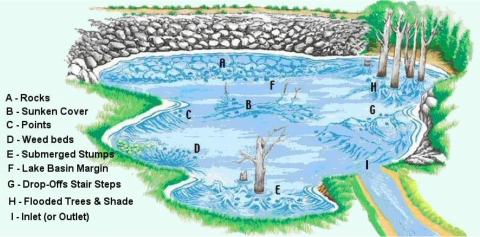
Seeking protective cover, foraging amongst rocks, stumps, weeds, at times on the prowl hunting for prey, other times just ‘lunching’ around casually, all seem to be part of The Bass feeding rituals and repertoire. Taking advantage and considering this when starting out and every time casting, will benefit you greatly.
Another is “competitive advantage”, The Bass has an “airtight sac” (breathing bladder), that is inflatable, which enables it to swim and thrive at different levels. A powerful tail helps with speed, agility and maneuverability. It can reach great depths.
Other factors like water clarity, time of day, subdued sunlight, water displacement and vibration sensing, noise sensitivity, all add to this fish’ cunning and ensuring that you scrutinize these clues, will increase your odds of hooking your next big one.
Unlocking for example how The Bass senses and prefers color and shade in the moment, can always also help anglers increase their effectiveness. The choice and type of lure, colors and movement, bait etc. can all contribute meaningfully to your attempts.
Where the fish are… everyone will have an answer, or at least their opinion/experience on what/where/when, even science. Nevertheless, sometimes it is as simple as understanding the habitat and those that live and thrive in it, to better interact with and enjoy fishing in it – a type of exploring the depths, so to speak. For example: the temperature of the water and available oxygen, dictate moving patterns and disbursement of fish species. Feeding habits and preferences are distinct, falling more on the “looking alive” or live bait. Some quote smallmouth bass, as showing preference for crawfish and using that as a ‘sign’ of where these critters will be found, on the hunt for their favorite snack! Looking at stomach content of fish you have caught and kept (not part of the catch and release protocol/requirements), hold hidden clues about food of preference –whitefish, crawfish and others.
Having self-confidence, aptitude AND the right attitude when fishing for Bass is crucial. In this battle to outwit your opponent, you will need every tool and trick at your disposal to make a successful catch. Never get discouraged, feel beaten or worse quit for the yield has been slim to none at all – those days happen to every angler. Nature beats to its own drum, you have to discover and enjoy the rhythm you are so intricately part of.
Practice makes perfect – there is no silver bullet, quick-fish method for $9.99, that can guarantee you bites and more bass all the time, anytime. It DOES take hard work and commitment, persistence and rigor from the angler. There is more than routine at stake and play here. Some days will be predictably better than others. No matter what the conditions, process and outcome, on the day, put it all down to experience and lessons learned. Log and learn, share and grow, in your own understanding, confidence and toolkit, as an avid bass angler.
Another key trick, is actually NO TRICK AT ALL – we call it an “acquired skill”. It takes more of that hard work we mentioned before! Exact, fixed casting, requires target-precision practice, improving your ability to place the lure exactly where you would want it to be – let us call it ‘hitting the mark’. This is another crucial tactic and technique you can practice in the park or your living room – try using plugs and get better every time at consistently hitting your ‘target’ (and nothing else we hope!).
Becoming and being a proactive participant in the context and environment (and process), you are in, knowing when to move on, change something and or quit for the time-being (postponing the hunt or resting when required, planning your strategy for the next trip out), is what it is all about as well!
Habitual creatures of comfort, The Bass (as a species), are not so much different than modern man. Bearing this in mind will help you too as an angler. We like what we like, when and how we like it and normally want it on time, when it is there and ready, be safe, enjoy life and we crave comfort – food, shelter and well-being! Does this sound a lot different from our own needs and requirements? Not really! Well, that is one way of leveling the playing field. Understanding the basic necessities and niceties for these watery “creatures”, holds clues and advantage, for any and every angler.
Stimulus, pattern, routine, habit – predictors and hints – the ace up your sleeve when nothing else works! Learn and develop skills, to ‘read’ (quickly at a glance, observe and make a judgment), know instinctively what will come happen, next and why – figure out the pattern, stick with it and exploit it to your advantage and angling success. Meet the Bass where they are, in what they do, cater to their needs and you will be surprised at what meets you in the waters below!
Thursday, February 19, 2015

Wednesday, February 18, 2015
Introduction - What and where are The Bass?
Bass defined: A fighter, ever-elusive, choice game-fish, predator by
nature and reputation, the one sought-after, prized hook, catch, reel-in and
land, of many an aspiring angler.
How to catch Bass AND then catch more, larger bass, more often, in
more places, with more consistency, having a pro-active plan and approach,
stacking the odds in your favor to succeed, catching more fish and enjoying the
process, is what this basic guide is all about.
The hunter becomes the hunted – learn how a small change in your
paradigm, thinking and approach can lead to bass-angling success! Start
thinking like the watery hunter, become and understand the bass as a hunter.
Observe, learn, follow, study and use its natural habit, preferences, patterns,
habits, prey and choice of food, in your angling-strategy, and you will have some
interesting fish-tales to tell. (None of them tall tales of course,we hope!)…
and YEAH, we may even learn something from the ones that get/got away!
So, let us get our rods and reels going…
If you were told that, there is one particular species of fish that
most would describe as tough-minded, smart, outwitting and elusively hard to
catch, then it the Bass – in all its shapes, sizes, iterations and sub-classes.
It rings true, no matter what the context, body of water, special and
or any situation or condition, regardless of secrets, tips, proven science,
technique and intent in the world! Bass fishing is challenging and rewarding at
the same time. To ensure hours of countless pleasure, follow the pointers (and
add some of your own here too!) provided here, for Bass fishing 101 and be
ready to hook the next big one… repeatedly, and actually be able to ENJOY it
too!
There are various aspects, working in combination in the art and
science, sport and pursuit that is Bass Fishing! Strategy and synergy,
contribute to eventual, and (we will argue), consistent and repeatable success.
Equipment, site, lure and skill, dawn and or dusk, shallow or deep waters,
fresh/salt water, from boat or shore – it does not matter! There are secrets
and techniques for each of them.
Novices, beginners, seasonal and seasoned anglers alike, are all
welcome to flip through these pages to discover some magical, sought-after
truths about bass fishing! In the end, it is as much about the process,
enjoyment, understanding and appreciation, as it is about the fish!
Become an observant, student of nature itself, the Bass’ habits and
patterns, whether using trolling, artificial and or live bait, fly-fishing, on
ice, fresh and salt, deep and shallow waters, do so, using all to your
advantage, as you undertake your own journey of the Bass!
Bass is by far the most widely distributed fish in North America –
sometimes due to the convenience of our mobility and fast-paced society, geared
for travel and transportation, Bass is within easy reach (for most within 1
days’ travel at most), Large-mouths, Small-mouths, striped, spotted, black bass
etc. all await.

Ever heard of a smart fish that makes calculated, in-the-moment
decisions? One whose survival instinct is so strong, that it snatches and at
other times totally ignores and hangs around seemingly uninterested, only to
strike/bite when least expected!
Well, that would be typical of our finned, scaly (pardon the pun),
fish-friend, the ‘Bass’. For the purposes of this book, this species is and
takes centre-stage –this is deliberate and intentional. Bass fishing is about
exactly that the fish, The Bass. Tenacious, unpredictable and a challenge to
most of us.
Various scientists have proven that Bass almost ‘calculate’ the amount
of energy it will take them to go after the prey vs. the return. If this be
true and verified, what are the implications for us anglers of promise?
OUTSMARTING THEM of course! It is all in the basics, the strategies, battle
plan, allure, tease and techniques we choose to use in this process. This will
dictate and determine our success.
Tuesday, February 17, 2015
Bass Fishing (What is that?)
Whatever the reason you had for picking up these pages, to
learn more about fishing, and game fishing, specifically with an all-time angling
favorite embedded in the aptly titled: Bass
Fishing: How To Catch The Next Big One, you are sure to find a quenching reprieve.
Still your thirst for knowledge and any bass fishing pursuit, challenge or
battle, you will or might face in your lifetime, right here. There is something
for everyone in this blog!

If your main interest, is improving your ability to catch
Bass, increasing, (and maybe) even stacking the odds in your favor of succeeding
time and again, every time, in this angling equation and any future expeditions
you plan to undertake, then this book has something of value to offer you.
When you are on the hunt for Bass, knowing the basics is
like the lifeblood of your strategy, bringing your chances alive with every cast!
ALSO, discover and develop YOUR OWN sportsman-like, angling
style and character, while gradually building your appreciation and
understanding of the great outdoors, as part of your fishing experience.
Our focus, approach, aims and goals are simple – the basis
and premise even simpler: learn the basics, get them right, consistently, with
skill and mastery, and they will eventually lead you to catching all the Bass
you can possibly want or handle!
Most anglers depict Bass fishing as the ultimate angling experience
and ‘The Bass’ (predator-hunter itself), as toughminded, unpredictable, with a
strong survival instinct, great awareness, sensing/sensors, that make them the
keen and effective hunters they are.
These fish benefit from natures’ gifts of powerful sight,
hearing, vast speed, maneuverability and even jumping action moves, that will
have you catch (pardon the pun), your breath… with awe, excitement and
expectation that is! All of this makes it possible for the Bass to live up to
its name and reputation, as one of the “extremes” of the gaming fish
populations and every angler’s dream catch!
Part of the Percichthyidae family (also sub-classified into
the genus Morone – considered a separate unit or branch (white, yellow,
striped), they are widely distributed in temperate and tropical waters,
sub-species to be found in fresh and saltwater. There are also the Australian
bass (Acquaria novemaculeate), European sea bass (Dicentrarchus labrax).
Their food of choice/feed and natural diet includes small
fish, crustaceans, worms and insects – some anglers have also had great success
with live-bait, like eels and even frogs.
Then there are the black bass, collectively referred to and
including our prized target – called by some to be the most sporting species in
North America – the Centrarchidae family. (Largemouth and smallmouth bass,
redeye, spotted, striped, black bass, Suwannee, Quadalupee).
Artificial baits have proven useful to most anglers. Live
baits are best, but these fish can be tempted, teased and lured to strike with
artificial ones such as spinners, spoons, crank-baits, surface plugs and
plastic worms – more on this a little later. Knowing which to choose (and WHY),
use, switch to in certain conditions, and how to optimize this art of allure,
is a key basic element for every aspiring or great angler alike.
These fishes are all active predators, warming to natural
baits and artificial lures. Most anglers would suggest spinning or trolling for
freshwater fishing for Bass (larger species) and spinning or fly-fishing for
the smaller species. Saltwater enthusiasts might also consider surfcasting,
trolling or up-tide fishing.
Fishing for and catching Bass, in various waters across the
globe, has a proud history and tradition. Most of us are too glad to get dabbling
in and form part of it, whether from boat, shore, rocks or rocks, rivers,
streams, lakes or oceans. We like to tell our mighty tales and contemplate how
to change and modify, adapt and or create new techniques, approaches to hook
smallmouth, large-mouth, speckled, spotted, striped and black bass. To each his
own. You pick your favorite.
Knowing how to tell a smallmouth from a large-mouth bass,
striped from spotted and so on, is a very basic skill most anglers master
quickly. Looking specifically at size and physical features are good places to
start. Train your eye to ‘spot the differences’, so to speak.
They differ in size, markings and dorsal fins for example.
Their upper jaws are different in length and their dorsal fins are not the same.
The large-mouth has a spiny dorsal fin, highest in the middle portion, with
almost a distinct ‘break’, right before the second set of dorsal fins start.
For our friends the small mouth bass, these fins are flatter, first and second
are connected, with distinct scales at the base of the second set of dorsal
fins.
Apart from knowing and telling your fish species apart, by
sights and or physical characteristics, there are some general advice we can
propose right upfront. Experiencing, treading lightly and honoring nature, the
great outdoors, abiding by the anglers’ code (catch and release, licensing),
environmental protection for generations of anglers (and women) to come, and
the like are all vastly important in your angling endeavors.
Second, maintaining an overall alertness, what some call
“reading the waters” (understanding the body of water, habitat to the fish, contour,
depth, temperature, stratified levels etc.), being generally, as well as
specifically ‘observant’, arming yourself with knowledge, skill and
understanding of the fish, the species, the environment, and all other relevant
factors to your fishing activity and undertakings – paramount for successful
process and outcome.

Third, (and almost most importantly), remain adaptable, for
change is a BIG part of this enjoyable outdoor activity. It is definitely not
for the faint of heart or the impatient among us!
Subscribe to:
Comments (Atom)